


Brian Kesling
2020 D. P. Russ Jr. and Walter S. Jones Sr. Alumni Award for Teaching Excellence
Chemical reactions
Professor’s methods have his students engaged, performing higher on standardized chemistry exams
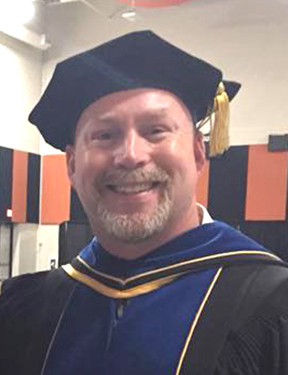 Dr. Brain Kesling has a Ph.D. in physical chemistry from West Virginia University and is an assistant professor of chemistry at 羞羞视频.
And he鈥檒l be the first to tell you. Chemistry is hard.
鈥淚t was the hardest subject for me in college,鈥� he says, 鈥渁nd I鈥檓 pretty hard headed. So I kept taking courses trying to figure it out. After college, I felt like I didn鈥檛 know enough chemistry to get a job in the field, so I went to graduate school.鈥�
Toward the end of his graduate career, Kesling鈥檚 advisor asked me if he would cover a couple of his lectures while he was going to be away at a conference. Kesling agreed to do it and ended up 鈥渉aving a talk鈥� with his class at the end about their unruly behavior.
鈥淲hatever I told them seemed to have an effect, and after my advisor came back, his class was so well behaved that he said I should consider becoming a professor.鈥�
His advisor鈥檚 instincts were right. Kesling is the 2020 recipient of the D.P. Russ Jr. and Walter S. Jones Sr. Alumni Award for Teaching Excellence. His colleagues and students tout his work to improve the general chemistry curriculum, which serves as the foundation for further study in many scientific fields. While at 羞羞视频, Kesling has developed a standardized course structure that is similar in rigor to courses at other major universities and which all general chemistry instructors now follow.
Again, chemistry is hard. But Kesling鈥檚 students at 羞羞视频 go on to consistently score above the national average on standardized American Chemical Society general chemistry exams. Kesling helps students develop critical thinking skills through evidence-based teaching strategies, Socratic methods of questioning and online homework to provide immediate, varied feedback.
He has presented at national meetings such as the Biennial Conference on Chemical Education to share his success in using these strategies.
鈥淎t one of the faculty orientations a few years ago, there was a law professor who demonstrated his use of the Socratic method [which stimulates critical thinking], and I was really impressed,鈥� Kesling says. 鈥淏ut I was confused about how I could implement it in a freshman class.鈥�
Kesling鈥檚 lectures involve a lot of pre-class reading for the students, random presentations before their classmates [so students feel pressured to come prepared to each class], back-and-forth discussions with students and a lot of Q&A. He encourages his students to applaud correct answers in class, and missed questions are followed up with second chances and bonus questions.
鈥淥nce students prepare adequately for class and see that they can do the work, the atmosphere becomes more positive and they are willing to work harder,鈥� Kesling says. 鈥淢ore effort from the students translates to better scores on exams.鈥�
His colleague, assistant professor of chemistry Dr. Evan Reynolds, once overheard Kesling discussing with a student the concept of atomic orbitals and their shapes 鈥� a complex subject that many students struggle to understand, Reynolds says.
鈥淒r. Kesling, however, was able to create a very relevant analogy between orbital shapes and balloons,鈥� he says. 鈥淯pon hearing the explanation, the student immediately exclaimed, 鈥楾hat makes so much sense now.鈥�
鈥淓ven more impressive, the student was not even in his class.鈥�
Kesling explains the satisfaction he gets when a student 鈥済ets it.鈥�
鈥淚 had some terrible experiences along my educational journey with professors who seemed to take pride in seeing students struggle,鈥� he says. 鈥淗elping someone in need is our Christian mission, regardless of whether we are providing food to the hungry or helping someone to understand the course material that they need in order to move on with their career or studies. Seeing students master the material in any of the courses I teach, and then watching them move on to careers in science or graduate programs, gives me the satisfaction of a purposeful life.鈥�